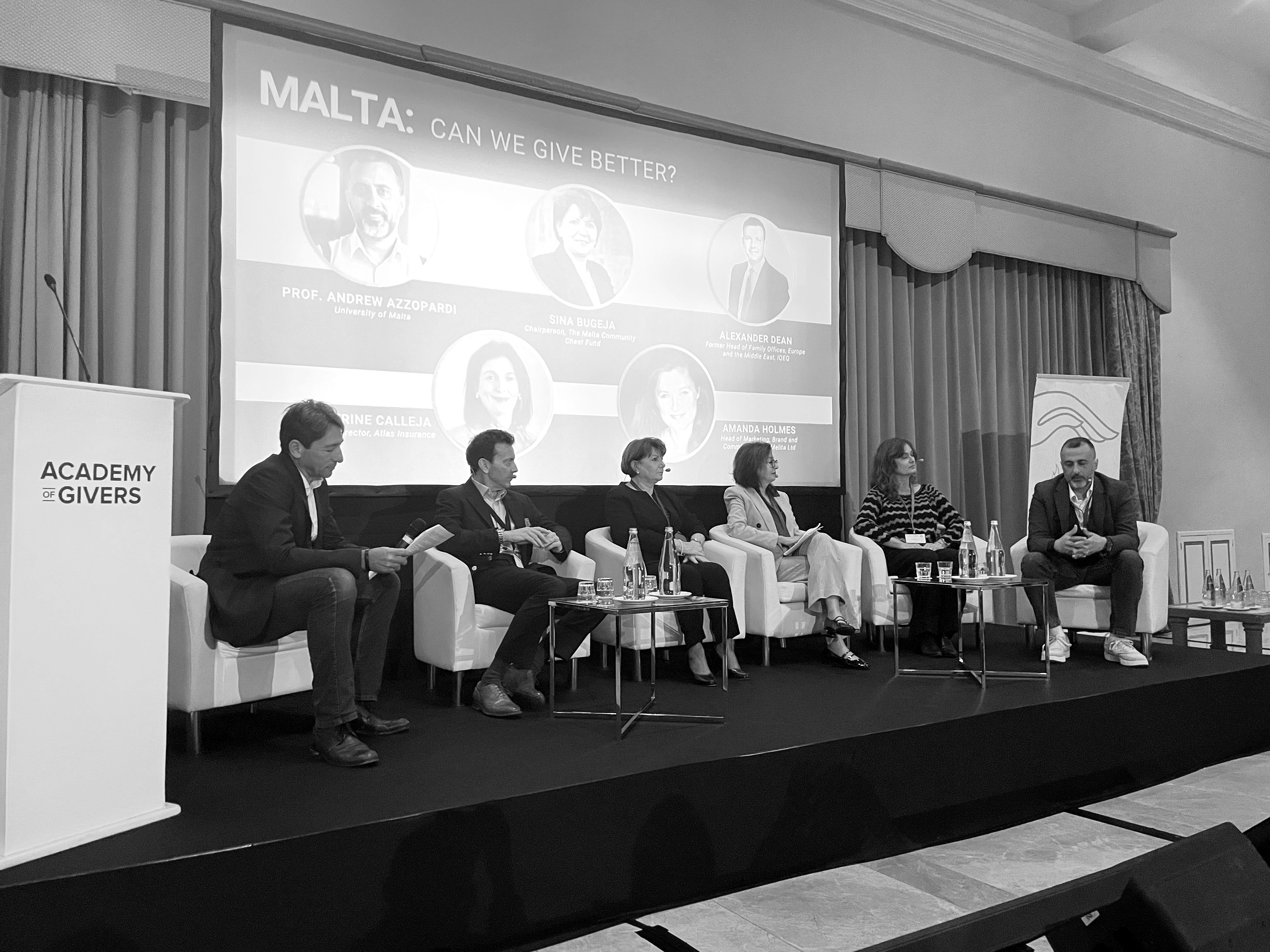
On 24th March, we found ourselves in a room shaped by thoughtful discussion and expert insight, at the Academy of Givers’ Annual Conference. Under the banner “Giving Better,” the theme of the day centred on sustainability, exploring Malta’s growing social, environmental, and structural pressures through the lens of philanthropy, purpose, and responsibility.
Held in the impressive surroundings of Xara Lodge, Rabat, the conference was well-attended and marked by positive energy, in-depth discussion, and plenty of rallying calls. Yet despite the momentum in the room, it also left behind a few nagging questions about broader sustainability in Malta.
It was encouraging to see how far the conversation has evolved: there is now a much stronger recognition that a business is no longer defined solely by what it delivers, but increasingly by why it exists.
This shift matters, because until fairly recently, value was measured in financial terms alone. Today, impact is part of that equation. The way a business contributes to society, supports its people, and engages with the world around it is no longer peripheral, it is central.
And yet, as the conversations unfolded, there was also a sense of déjà vu – the feeling that, despite all the progress in language, not much has shifted in practice over the past few years.
The rhetoric has become more sophisticated, but the level of real action has not kept pace. We remain, for the most part, stuck in a mode of exploration, still discussing what companies ought to consider before they begin sustainability reporting, still unpacking frameworks, debating readiness, and questioning where to start – the same conversations we were hearing back in 2023 and 2024.
These are important conversations, but they are no longer new, and at some point, the continued focus on preparation starts to feel less like caution, and more like avoidance.
Let’s unpack what we mean:
1. Fragmented strategies
In our work, we frequently sit with leaders who describe themselves as being at the beginning of their sustainability journey, but when you look more closely, that is rarely the full picture.
Most organisations are already doing more than they realise. They are making people-focused decisions, supporting their teams, improving operations, engaging with communities, and making choices that align with ESG principles, whether they consciously frame them that way or not. The issue is not always a lack of action, but rather a lack of structure, clarity, and ownership.
What exists is often fragmented, disconnected, and invisible. Good decisions are being made, but they are not being measured, linked, communicated, or built into strategy, which is exactly why sustainability continues to feel like something external, technical, and slightly out of reach, rather than something already embedded in the way the business functions.
This is where the gap lies. Not in awareness, and not even in intent, but in translation. Because until sustainability is understood in the context of business performance and how it influences growth, strengthens relationships, and shapes long-term resilience, it will continue to sit on the sidelines.
Too many organisations still treat it as though it belongs in a separate category, somewhere between compliance, communications, and corporate responsibility, rather than recognising it for what it actually is: a strategic lens through which resilience, relevance, trust, and long-term competitiveness are built.
2. Sustainability on the sidelines
At the same time, there is an persistent underlying hesitation that is harder to ignore. What is lacking is any sense of urgency. For many organisations, sustainability still feels like a future obligation rather than a present responsibility. Time is being spent aligning internally, seeking buy-in, and waiting for clearer direction.
But the external environment is not waiting. Markets are shifting, expectations are rising, and regulation is accelerating whether businesses feel ready or not. The question is no longer whether sustainability will become a business requirement – because it already has. And while Malta may be a small island nation, we are by no means insulated from that wider reality.
In many ways, we are moving in the same direction as the rest of the world, but if we’re honest, we are doing so more slowly, more cautiously, and often more reactively. There are clear signs of progress – workforce participation has improved, conversations around representation are gaining traction, and awareness is growing. But awareness is not the same as change, and when you look beneath the surface, the structural gaps remain difficult to ignore.
3. Your leadership shapes your agenda
Leadership structure, in particular, tells a story. In Malta’s largest companies, only around 16 to 20 out of every 100 board members are women. That is not simply a statistic to cite in a panel discussion or sustainability report. It reflects something deeper about who still holds influence, who shapes decisions, and whose perspectives continue to be underrepresented in the rooms where strategy is set.
Alongside this, the gender pay gap remains another reminder that talent is still not being valued equally, regardless of how progressive we may like to think we are. These are not only social concerns; they are business and economic concerns too. Because when representation is limited, perspective is limited, and when perspective is limited, so is potential.
4. The reality on the ground
The environmental side tells a similarly uncomfortable story. Government support remains inconsistent, and enforcement is too often weak or under-resourced. In many cases, responsibility continues to be carried by NGOs, volunteers, activists, and private individuals who are trying to protect and preserve what should already be properly safeguarded for the nation through systems, institutions, and policy. That should concern all of us.
In Gozo, for example, there is still no dedicated Environmental Protection Unit within the police force, which means that issues such as illegal hunting, illegal construction and environmental degradation are being monitored or handled without the specialist training and resources they require. That is not a small operational gap – it says something more fundamental about where environmental priorities still sit in practice.
5. The Maltese contradiction
Taken together, these different dynamics paint a picture of a country that understands the importance of sustainability, but has yet to fully operationalise it. We talk about it more often, we understand its relevance more clearly, and there is far more alignment in principle than there once was.
But we have not yet embedded it deeply enough into the way we do business, the way we lead, or the way we govern. That, perhaps, is the contradiction Malta is still sitting in: we increasingly agree with sustainability as an idea, but we are still hesitant when it comes to treating it as a discipline, a responsibility, and a real operating priority.
And yet, that is also where the opportunity lies. Because the next phase of this conversation should not be about generating more awareness – we already have enough awareness. It should be about application. It should be about helping organisations move from fragmented good intentions to joined-up action, and recognising that they do not need to start from scratch, nor wait until every framework, report, or compliance requirement is perfectly in place before they begin.
In many cases, the foundations already exist. They simply need to be connected, strengthened, measured, and treated with the seriousness they deserve.
When sustainability is approached in that way, it stops feeling like an abstract burden and starts becoming what it should have been all along: a lens for building better businesses. More resilient businesses, more relevant businesses, and ultimately, better-led businesses.
Because in the end, the question is not whether Malta understands sustainability. It does. The real question is whether we are finally ready to stop fine-tuning the conversation, and start doing the work.
That is where real change begins.